What a W-2 soldier actually is
Not a soldier, necessarily. The W-2 soldier is anyone on payroll whose job is substantially to be there — awake, present, watchful, on the clock — so that a process has a human attached to it. The night operator. The yard checker. The person who walks the line with a clipboard. The one who drives four hours to look at something and drives four hours back.
These are real jobs done by skilled people, and the skill is real. But a large share of the hours are not skill. They are presence. And presence is the single most expensive thing an organisation can buy from a human being, because it is the thing that costs them their life rather than their expertise.
What ends
The requirement that a person be physically present and awake for the machine part of the work. That is it. That is the whole ending.
- The 3am shift that exists because something must be watched.
- The drive that exists because something must be looked at.
- The stationed hours that exist because a process cannot be left alone.
- The overtime that exists because endurance is the deliverable.
What does not end
Judgment. Every novel situation, every case the model has not seen, every decision with a moral weight to it, every moment where the right answer is to stop and ask a human — those stay human, and they get more human, because they stop being buried under twelve hours of presence.
The W-2 soldier does not lose. The W-2 soldier gets to leave.
The man in the last panel
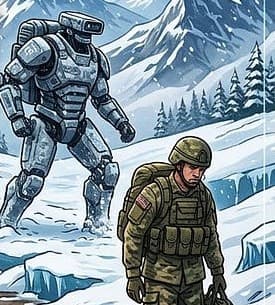
In the winter panel of the artwork there is a soldier walking downhill, away from the units, carrying his kit. Almost everyone reads him as defeated. He is the most optimistic figure in the picture.
He is walking out — at the end of a watch that no longer requires a person to stand it. The units behind him are going up the hill into the snow because that is a machine’s job now. His job is the part that needed a person all along, and he is going to do it somewhere warm, on a schedule that lets him see his family.
The honest part
It would be dishonest to pretend this is painless. Roles that were mostly presence do not survive as they were, and a company that runs this doctrine without a plan for those people is running a layoff with better branding.
The argument here is not that nobody is affected. It is that the affected work is work nobody should have wanted to sell in the first place — and that organisations which handle the transition honestly end up with the same people doing the part of the job that was always worth paying for.
The full argument is in the white paper
Operation Vivaldi — the doctrine, the architecture and the industry case, as a PDF.
Request it